 Bank Zenit
 Renaissance Bank
 LOCO-Bank
 T-Bank
 Bank Sinara
 Credit Europe Bank







Annuity and differentiated loan payments

How annuity payments work
An annuity payment is the most common payment type in modern lending. It was originally created to make loan repayment more convenient for borrowers, as the payment amount remains largely the same from the beginning to the end of the term. Banks later realized that this type is also quite profitable for the lending institution itself, which is why annuities quickly became widespread everywhere.
The main feature of annuity loans is that the payment remains equal from one payment period to the next, while its internal structure changes over time. At the beginning of the annuity repayment period, the borrower primarily pays off the loan interest and only then the principal. The share of the principal payment increases over time, and in the second half of the term, the client pays mostly the principal. This makes fulfilling obligations relatively painless.
Annuity payment calculation formula
The calculation formula in this case is not simple:
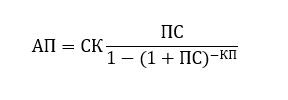
Where:
- AP - annuity payment.
- LP - initial loan principal.
- IR - interest rate.
- PP - number of payment periods (most often in months).
This formula is used by the overwhelming majority of banks. However, you can also have the payment calculated with the bank's assistance, as the payment schedule is provided to the client free of charge.
Calculation example
For example, if a client borrows 1000 conventional units for 12 months at an annual interest rate of 12%, the formula dictates a monthly payment of 92.63 RUB, with the first payment consisting of 75.67 RUB toward the principal and 16.67 RUB toward interest, the next consisting of 77.23 RUB toward the principal and 15.40 RUB toward interest, and so on until the final payment of 91.12 RUB and 1.52 RUB, respectively.
There are quite a few payment methods that reduce overpayment during the loan repayment process. Loan calculators are also available, including on bank websites, which allow you to calculate the payment using the loan amount, interest rate, and desired term.
We will find offers tailored to your situation
Leave your phone number, and we will show you options with a high approval probability and current terms.
- Verified offers
- No calls from managers
- Results delivered through your preferred channel
What is a differentiated payment and how it works
A differentiated payment type is an older loan format where the principal debt is divided evenly across the payment periods, and interest is accrued on the remaining balance. Consequently, the initial payments are significantly larger than with an annuity, but the total overpayment is lower. It is hardly surprising that this type of loan is becoming increasingly rare.
Formula for calculating a differentiated payment
The formula for calculating payments for a differentiated loan type is simpler:
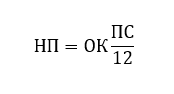
In the formula:
- AI - accrued interest.
- LB - remaining loan balance for the month.
- IR - interest rate.
Calculation example
With a differentiated payment on a loan of 1000 conventional units for 12 months, the first payment will be 100.0 RUB, comprising a principal amount of 83.33 RUB and interest of 16.67 RUB. Afterward, the principal debt decreases, and while the principal payment remains constant at 83.33 RUB, the interest amount drops to 15.28 RUB (since after the first payment the debt amount became 1000 - 83.33 = 916.67 RUB, and interest was accrued on that amount).
Annuity or differentiated: which is more profitable

It all depends on the nature of your earnings. If a client has irregular income and the loan amount and term are not very large, a differentiated loan type is more profitable. An annuity is more beneficial for those whose earnings are lower but more stable, as it allows the amount to be distributed in equal payments over the entire term. Each person must decide for themselves.
However, keep in mind that far from all banks are ready to provide the exact loan type a borrower desires. Currently, loans with a differentiated payment type are extremely rare on the market, so a person's choice is severely limited. Take this into account during your search.
Can a client choose the loan repayment schedule themselves
It all depends on the specific scheme being offered. Most overpayment reduction schemes involve early repayment. Ever since banks were prohibited from charging early repayment penalties, depositing more money than required for the regular payment has become advantageous. Many borrowers pay off their loans within a year, although this requires intensive efforts to source cash flows.
Q&A
Is it possible to switch from one loan type to another during the repayment process?
No, banks do not provide such an option. The only alternative is to refinance a loan of one type using a loan of another type. But most of the time, it is simply not worth it.
How can I find out what type of loan I have?
You can find this directly on the loan tariff page of the bank's website; according to the law, all legal financial institutions are required to publish this information publicly. You can also request the loan type directly from the bank. As a rule, when you obtain a loan statement, it indicates the loan type.
Why is the differentiated loan type rare?
Not only is it less profitable for the bank (the overpayment is slightly lower), but it also requires the borrower to make very large payments during the first half of the loan term. Not everyone can afford large sums at regular intervals, so back when this loan type predominated, the default rate was high, which increased risks. For this reason, annuity-based loans were introduced.
0% for 10 years
From 0 %
Limit - up to 500000 RUB
Период - 0 дней

Срок кредита до 7 лет
From %
Лимит - до 3000000 ₽
Минимум - от 1000 ₽

Срок кредита до Уточняется
From %
Limit - up to RUB
Minimum - from RUB
Other posts